
The Inflammaging Engine
How a Tired Liver Accelerates Your Biological Clock
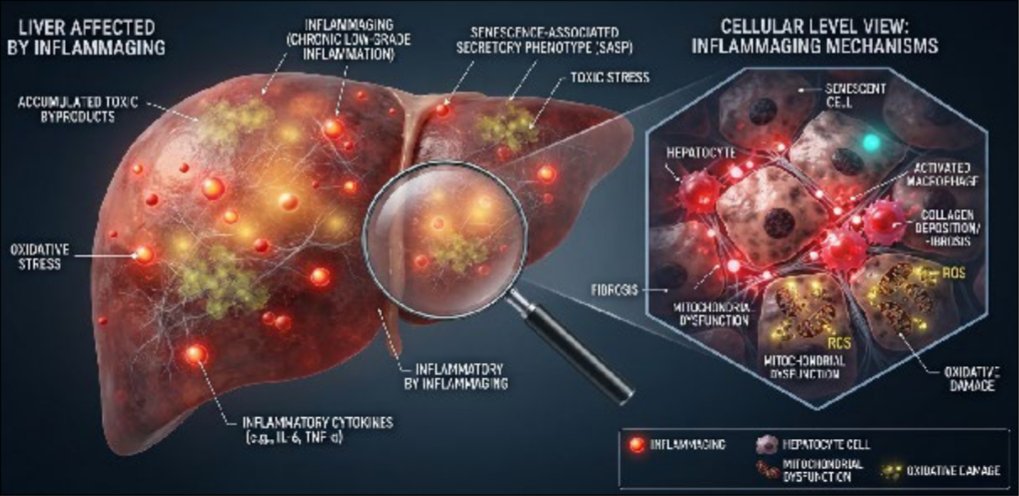
Natural processes in the liver inherently increase inflammation and contribute to inflammaging as we get older, and allowing the liver to lose function because of toxic overload prematurely fuels aging and inflammaging effects. Nutritional support can ease inflammation, whether it is due to aging or toxicity (or both), and provide optimal results for any anti-aging protocol.
The liver plays a central role in the aging process, particularly in the phenomenon known as “inflammaging” — the chronic, low-grade systemic inflammation that typically develops as individuals grow older. As the body’s primary metabolic and detoxification hub, the liver is continuously exposed to an array of circulating antigens, metabolic byproducts, and gut-derived bacterial toxins.
Over time, persistent metabolic stress, cumulative oxidative cellular damage, and mitochondrial decline impair the liver’s functional efficiency. This cellular degradation triggers the activation of inflammasomes within the liver, transforming the organ into a continuous source of low-grade systemic stress.
Furthermore, as liver cells age, they transition into a state of cellular senescence. Sometimes called “zombie cells,” these senescent cells release a specialized cocktail of signaling proteins called the senescence-associated secretory phenotype (SASP).
SASP factors overstimulate the liver’s immune cells. These chronically activated immune cells generate an overabundance of pro-inflammatory signaling proteins that enter the bloodstream, driving systemic, low-grade inflammation throughout the entire body and linking localized stress in the liver directly to systemic inflammaging. For more detailed information on senescent cells, please see the following articles in The American Chiropractor — “Cellular Senescence: Why We Need to Pay Attention” in May 2025, and “How Toxins are Aging us” in January 2026.
While chronological aging brings a natural, intrinsic decline in cellular quality control, environmental and metabolic stressors aggressively drive a phenomenon known as “premature” or “stress-induced” cellular senescence. That’s where nutritional support comes in to quench the raging fire of inflammaging both in the liver and systemically.
Nutritional Support for Healthy Liver Inflammatory Balance
Milk thistle (Silybum marianum) has a long history of traditional use in natural liver detoxification pathways and general liver vitality. Clinical observations indicate that milk thistle can help maintain healthy baseline levels of key liver enzymes, such as alanine aminotransferase (ALT) and aspartate aminotransferase (AST), which serve as markers for stable cellular integrity.
By optimizing general liver function and guarding against consistent inflammation, normal cellular longevity is promoted. Milk thistle helps support the body’s natural defense against systemic oxidative fatigue and can be considered a useful botanical tool for preserving long-term liver health.1
Silymarin is the primary active extract derived from milk thistle, consisting of a complex mixture of flavonoligans that deliver targeted antioxidant support. Silymarin supports the regulation of pro-inflammatory cytokines on inflammatory signaling pathways.
Additionally, it interacts with cellular metabolic sensors to help the liver adapt to environmental and metabolic stressors, encouraging a calm, balanced cellular environment. Comprehensive reviews outline how silymarin neutralizes free radicals, significantly reduces elevated ALT and AST, and maintains normal structural integrity within hepatic tissues.2,3,4 It works at the cellular level by stabilizing hepatocyte membranes against circulating stressors that can increase inflammaging.
Cordyceps contains potent, naturally occurring bioactive and adaptogenic compounds, which help the body adapt to metabolic stress. This adaptation helps take some of the pressure off the liver by reducing the stress that results in inflammaging. Cordyceps helps protect hepatocytes from oxidative stress and mitochondrial fatigue, thereby supporting normal tissue structure and mitigating age-related metabolic imbalances.5
Green tea (Camellia sinensis) is rich in highly bioactive polyphenols known as catechins, with epigallocatechin-3-gallate (EGCG) being the most prominent. These natural compounds bolster the body’s endogenous antioxidant defenses, directly neutralizing unstable free radicals that would otherwise cause oxidative stress to aging liver tissue. By reducing localized oxidative burden, green tea intake can help manage the systemic accumulation of age-associated inflammatory signals.
N-acetyl cysteine (NAC) is a direct biochemical precursor to glutathione — the body’s premier endogenous antioxidant. It is crucial for natural hepatic detoxification and metabolic filtration. By replenishing intracellular glutathione stores, NAC optimizes the liver’s ability to neutralize metabolic waste products and environmental toxins before they trigger an inflammatory cascade. Maintaining glutathione production supports healthy cellular repair mechanisms and downregulates the oxidative stressors that feed chronic, age-related systemic inflammation.
Dandelion (Taraxacum officinale) naturally assists the body’s normal digestive and waste-elimination processes by encouraging healthy bile flow and efficient hepatic filtration. By supporting regular fluid balance and assisting the liver in clearing metabolic byproducts, dandelion helps prevent the buildup of cellular debris that can aggravate immune cells and contribute to inflammaging.
Burdock root (Arctium lappa) is valued for its rich composition of active phytochemicals, including lignans and inulin, which support natural blood purification and systemic detoxification. Burdock works by assisting the liver and lymphatic system in the smooth elimination of metabolic compounds, thereby reducing the systemic burden placed on the immune system. This steady filtering support helps maintain a balanced baseline inflammatory state throughout the body’s tissues during the aging process.
In conclusion, a healthy, noninflamed liver can contribute to a long and healthy life. Supporting the liver throughout a lifetime with a healthy diet, exercise, and the right supplements can go a long way in escaping cellular senescence and inflammaging to keep the biological clock where it needs to be.
Dr. Lynn Toohey organizes seminars, acts as a nutritional consultant to Nutri-West (nutriwest.com) and authored the Functional Health Evaluation program that analyzes blood tests and DNA raw data (www.FHEcloud.com).
Dr. Toohey can be reached at 866-271-8888 or by email at drtooheynutriwest@gmail.com with any questions.
References
- 1. LiverTox: clinical and research information on drug-induced liver injury [Internet]. Bethesda, MD: National Institute of Diabetes and Digestive and Kidney Diseases; 2012. [Updated 2020 Jan 21]. Available from: https://www.ncbi.nlm.nih.gov/books/NBK548817/.
- 2. Dhande D, Dhok A, Anjankar A, Nagpure S. Silymarin as an antioxidant therapy in chronic liver diseases: a comprehensive review. Cureus. 2024 Aug 17;16(8):e67083. doi: 10.7759/cureus.67083. PMID: 39286715; PMCID: PMC11404857.
- 3. Calderon Martinez E, Herrera D, Mogan S, Hameed Z, Jangda AA, Khan TJ, Mroke P, Sajid S, Shah YR, Baig I. Impact of silymarin supplements on liver enzyme levels: a systematic review. Cureus. 2023 Oct 24;15(10):e47608. doi: 10.7759/cureus.47608. PMID: 38021897; PMCID: PMC10667129.
- 4. Malik A, Malik M, Qureshi S. Effects of silymarin use on liver enzymes and metabolic factors in metabolic dysfunction-associated steatotic liver disease: a systematic review and meta-analysis. Can Liver J. 2024 Feb 26;7(1):40-53. doi: 10.3138/canlivj-2023-0021. PMID: 38505782; PMCID: PMC10946183.
- 5. Tsai WT, Situmorang JH, Kuo WW, Kuo CH, Lin SZ, Huang CY, Ho TJ. Protective effects of Cordyceps militaris against hepatocyte apoptosis and liver fibrosis induced by high palmitic acid diet. Front Pharmacol. 2025 Jan 9;15:1438997. doi: 10.3389/fphar.2024.1438997. Erratum in: Front Pharmacol. 2025 May 09;16:1619149. doi: 10.3389/fphar.2025.1619149. PMID: 39850574; PMCID: PMC11755097.
Nutri-West Annual Symposium
January 29–31, 2027
Scottsdale, Arizona
On January 29-31, 2027, the Nutri-West Annual Symposium will be held in Scottsdale, Arizona. The conference will focus on “Inflammaging - The Connections of Inflammation and Aging (and Nutritional Support).” Seven well-respected speakers will showcase research and practical information to address this incredibly relevant issue that can take on various different slants.
Two of those speakers — Brandon Brock, DC, and Trevor Berry, DC — are experts in the field and have many intriguing ways to educate attendees about the topic. They draw from science, their own experiences/case studies, etc., and they promise to engage the audience with fascinating stories of how to deal with inflammaging, including nutrition and cold laser protocols that work very well.
Scan to register or visit bit.ly/NWS2027