
Off the Table and Into Motion
IMPAC instructor Dr. Paul Lindsey on range of motion adjusting, position of pain adjusting, and why your patients aren't stuck in neutral.
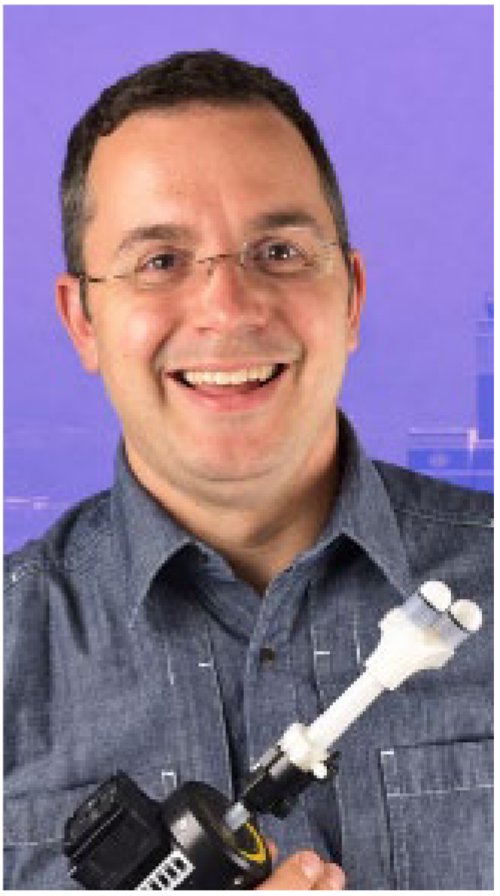
Dr. Paul Lindsey (PL) trained at the Welsh Institute of Chiropractic and built a successful practice in the United Kingdom before an unexpected move to the United States. After a hurricane drove his family out of Florida, they landed in Salem, Oregon. Only later did he learn that Salem is home to IMPAC Inc., maker of the ArthroStim he had used since his first months in practice.
IMPAC has built adjusting instruments in Salem since 1982. Engineer Ed Miller, who still owns the company, built the original ArthroStim. Dr. Lindsey is an IMPAC technique instructor who teaches manual and instrument-assisted adjusting through workshops and online CE courses at InstantChiro.com. In an edited excerpt of the TAC Tic Talk podcast interview, Dr. Paul Lindsay joins hosts Dr. Joe Busch (JB), editor of The American Chiropractor, and publisher Jaclyn Touzard (JT), to discuss instrument-assisted adjusting, the ArthroStim, and the techniques he teaches through IMPAC.
JT: You've got to explain this InstantChiro.com behind you. Everybody watching is going to be thinking there's no way you can be an instant chiropractor.
PL: You're starting fights early, I see. InstantChiro means instant chiropractic courses online. You can take your CEs in certain states online straight away. You don't become an instant chiropractor. That can't happen, unfortunately. Although I think most of us are born chiropractors.
JB: You work a lot with the ArthroStim. Tell us about that.
PL: Just a clarification: I don't represent them. I work with them. I'm their spokesperson, the person they send to do courses.
JB: You can change the speed on it, and that has an impact on the adjustment. How do its features compare with a manual adjustment?
PL: An adjustment is usually a toggle, or a directed, high-velocity, low-amplitude force. That's what these instruments deliver. There's a speed switch, so for very precise work like upper cervical, you can use single taps. When we do a manual adjustment, we get to end range and give it one thrust. Imagine if you could hold the window of that adjustment open and keep toggling through it, working the different vectors as you go. That's what we have.
JB: Most of the chiropractors I really respect use this type of instrument. I need any help I can get to get patients better.
PL: I think that's where most people are. They come to the ArthroStim when there's something they can't treat by hand, or they're hurting too much from practice. When they really find it, it's usually through position of pain or range of motion adjusting. Those are adjustments you can't do by hand, and in my opinion they're the biggest gains of the ArthroStim.
Patients Don't Walk Around With a Table Attached
JB: When I was younger, I thought you had to bring the thunder every time. As you mature in practice, you see that a lighter, very specific approach has a profound impact.
PL: Chiropractic has always been about specificity and intent. I still adjust people manually all the time. I love it; I was born to be a chiropractor. This just gives me more tools. The contact is about the size of a pisiform, we have full control of the amplitude, and I can adjust the power just by the force of my hand. We've all developed that feel, and you get it coming back from this instrument.
Patients don't walk around with a table attached to them, so why do we always treat them on the table? In the thoracic spine, nobody is usually stuck in flexion, and nobody is stuck in neutral. We're stuck going into extension. So if you extend while adjusting, you can go through a whole segment and different ranges of motion.
I have a saying, and it's mine, not IMPAC's: MTV. Instead of adding force, we add Motion, Time (duration) and Vectors. Add the motion of the spine, add the time, then adjust the vector until you find the exact one. With the ArthroStim, you can usually hear the sound change when you get the right vector.
JT: Instrument adjusting is well known for pediatric and geriatric cases. What other conditions is it best for, maybe less well-known ones?
PL: For me personally, functional frozen shoulder. Is it adhesive capsulitis? Mostly not. There are technique systems, which as far as I'm aware can only be done with the ArthroStim, that unlock it in one visit. People used to fly over from Ireland to get their shoulders done.
Athletes were the biggest group. In my pelvic torsion work, we do basically a prone straight leg raise while adjusting through the range of motion, and that really unlocks people's walking and running. If you push through that range and keep the window of the adjustment open, you'll be surprised how much motion you can unlock.
Most people buy an ArthroStim for pediatrics or geriatrics. Those are our fear points, and it's great for that. Then they go through an existential crisis: "I'm a chiropractor. I do things by hand." That's true, and I do things by hand every day, because this requires my feel and my direction. When B.J. Palmer was introduced to the drop table, he said it would revolutionize chiropractic. Wedges or blocks, flexion-distraction, drop tables: it's all just another thing we do with our hands.
JB: Most instruments I've seen are one instrument, one technique. With the ArthroStim, people have developed a lot of different techniques.
PL: There are over 20 techniques that use the ArthroStim, because it's not a be-all and end-all. It's an assistant. People think they have to do one or the other. I use the ArthroStim in most appointments, alongside manual adjusting. And you can't do a multi-thrust by hand. You can't do a side posture 16 times in a row while changing the vector.
Adjusting in the Position of Pain
JB: Tell us about position of pain adjusting.
PL: That's probably the second biggest thing people miss. I teach this all over the world, and most people who have the ArthroStim have never done range of motion adjusting or position of pain adjusting.
If it hurts when you swing a golf club, lying face down on a bench isn't the position that hurts. So you simulate the painful motion as realistically as possible, then go through that motion and adjust the segments involved, plus above and below.
Tennis elbow: why aren't we treating the radial head while the patient holds a racket and does the motion? Mothers carrying an infant can tell you exactly where it hurts. Why aren't we adjusting them while they hold an infant or something heavy? In my opinion, that would be the ultimate use of care.
With range of motion adjusting I describe it as a flea in a jar. The flea hits its head on the lid, and when you take the lid off, it won't jump above that line again, because it's learned that it hurts. Our bodies are exactly the same. If bending a certain way hurts, the body restricts that range. When we adjust through it, we stimulate the nervous system through that motion, and it gets a new picture.
If you've got an ArthroStim in your clinic, try it through the range of motion and see what results you get. I'd say I guarantee you won't go back, but I can't guarantee. That's a legal thing. Give it a try.
JB: With athletes before an event, or musicians before a concert, you can't get aggressive. There's really low risk with this type of treatment, and a really high ceiling.
PL: This isn't an official policy, but here's what I like to do. The first risky thing is your first adjustment, so I usually start a new patient with the ArthroStim and show them a range of motion increase. I have them look at points on the ceiling: "I couldn't see this bit before. Now I can." If they can do the painful motion before and no pain afterward, you're a genius. In my opinion there's less risk of a reaction, and the change is visual. You've won that patient for a long time.
JB: Any final words for our listeners?
PL: Everyone should read The American Chiropractor. If it's not written down, it's gone forever. And if you get a chance, try range of motion adjusting. It will change your practice. Borrow one. Do anything to get one.
Learn More
Courses with Dr. Paul Lindsey: Online CE courses, including Pelvic Torsion, are at InstantChiro.com. He says the courses are available for CE in more than 30 states (check yours), and he also teaches live workshops. Dr. Lindsey discloses a commercial interest in IMPAC Inc.
The ArthroStim and VibraCussor: Order from IMPAC at ArthroStim.store. IMPAC says the ArthroStim delivers 12 to 14 thrusts per second, with a four-year warranty and a 90-day return period.
Contact IMPAC Inc.: 1828 23rd Street SE, Salem, Oregon 97302. Phone 800-569-8624 (U.S.) or +1 503-581-3239 (international). Email infomail@impacinc.net.
Techniques That Use the ArthroStim
Dr. Lindsey says more than 20 technique systems use the ArthroStim. These are the ones we could confirm through each technique's own materials or published course descriptions. A listing here is not an endorsement, and some instructors disclose a commercial interest in IMPAC.
- Koren Specific Technique (KST) ★ Learn more: korenspecifictechnique.com
- CLEAR Scoliosis Protocol ★ Learn more: clear-institute.org
- Koch Method ★ Learn more: kochseminars.com
- Creed Neural Kinetic Integration Technique ★ Learn more: IMPAC's Dr. Creed page
- Trigenics Learn more: trigenics.com
- Applied Kinesiology (Dr. Eugene Charles) ★ Learn more: charlesseminars.com
- Principles 2 Adjusting ★ Learn more: InstantChiro.com
- Pelvic Torsion ★ Learn more: InstantChiro.com
- Range of Motion and Position of Pain Adjusting ★ Learn more: ArthroStim.store
InstantChiro key: ★ = online course or materials at InstantChiro.com, Dr. Lindsey's site.
Find this latest episode on Tic-Talk.net and on all your favorite streaming services as TAC Tic Talk.